Reality Hits at Least 1009 Americans!


Message Force Multiplier

"We the People are the first three words of the Preamble to the Constitution; and from its adoption until the Robber Baron Era in the late nineteenth century, people meant human beings. In the 1886 Santa Clara case, however, the court reporter of the Supreme Court proclaimed in a “headnote”—a summary or statement added at the top of the court decision, which is separate from the decision and has no legal force whatsoever—that the word person in law and, particularly, in the Constitution, meant both humans and corporations.
Thus began in a big way (it actually started a half century earlier in a much smaller way with a case involving Dartmouth University) the corruption of American democracy and the shift, over the 125 years since then, to our modern corporate oligarchy."
"McCain-Feingold was a good bipartisan achievement by conservative senator John McCain and liberal senator Russ Feingold to limit the ability of corporations to interfere around the edges of campaigns."
"But the law offended the members of the economic elite in this country who call themselves “conservatives” and believe that they should be able to spend vast amounts of money to influence electoral and legislative outcomes."
"By having free-speech rights equal with people, Stevens argued, corporations will actually harm the “competition among ideas” that the Framers envisioned when they wrote the First Amendment:
“[A] corporation...should have as its objective the conduct of business activities with a view to enhancing corporate profit and shareholder gain.” In a state election...the interests of nonresident corporations may be fundamentally adverse to the interests of local voters. Consequently, when corporations grab up the prime broadcasting slots on the eve of an election, they can flood the market with advocacy that bears little or no correlation to the ideas of natural persons or to any broader notion of the public good. The opinions of real people may be marginalized."
Read the rest of this '1st in a series' HERE.
(EDIT)
The original version of this post included a banner from wakeupwallmart .com. The links used for that banner now point to a UFCW union webpage where they are promising to make things better. I'm not sure if wakeupwallmart was always a part of this union website, but I do know they have removed all of the pages from the wakeup site. Perhaps under pressure from the giant one? wakeupwalmart com banners ticker ticker150x200 html

The US Government in the Health Insurance business? The arguments, when you can get down to those that are A) Real and B) Relevant, are varied. I've had a bit of difficulty drilling down to this list but think I've come to the gist of it. In part one we discussed the costs, in part two we discussed control and in part three we will review why American Healthcare when viewed in the long term is too all encompassing an American Problem we can no longer ignore.
Since this is America and short of revolution nothing, not even morals, weighs in heavier than money we will take another broader look at the economic impact our current health care system and it's lack of complete coverage for all Americans takes on us.
When your representative speaks to you about the cost of a plan, and how it will be paid for, there are always the stipulations that can be quantified either in costs or savings, but there are too those that cannot. The actual dollar amount of savings by providing a person basic health care (prevention and education) thereby avoiding high cost end stage treatments will not be fully addressed by the agencies responsible for providing data. Neither will the increased tax and wage dollars gained by small businesses opening that couldn't without the reform because the cost of employee health care put opening out of reach. No one will try to tally the money gained from increased productivity either, healthy people are happy and more productive, clearer thinking and dependable.
Why CBO Cannot Calculate the Savings That Will Come With Healthcare Reform -
"The CBO’s track record in predicting the effects of health legislation is abysmal,” observes Bruce Vladeck, the man who ran Medicare while serving as administrator of the Health Care Financing Administration from 1993 to 2997. “Over the last two decades, the CBO has routinely overestimated the costs of expanded government health care benefits,” Vladeck adds, “and underestimated the savings from program changes designed to reduce expenditures.”
In the early eighties, Congress adjusted the way in which Medicare would pay hospitals. Under the new Medicare woudl pay a fixed amount per admission based upon primary medical condition. “CBO predicted that by 1986 total spending would be $60 billion. Actual spending in 1986 was $49 billion.”
That’s $11 billion on 60. That’s wrong by more than 18%,” .Ricciardelli observes.
In the second case, Gabel “found that savings from the Balanced Budget Act of 1997, which changed the way skilled nursing facilities and home health services were reimbursed under Medicare, turned out to be 50 percent greater in 1998 and 113 percent greater in 1999 than the budget office forecast.”
“Wrong by 50% and by 113%.”
The Institute for Healthcare Improvement (IHI) has identified some 70 U.S. communities that already have managed to do what progressives claim health care reform can do: change how care is delivered so that it is both less expensive and more effective. As I reported here, IHI spotlighted 10 of those communities at a recent conference where IHI president Don Berwick stressed: “We don’t have to ration needed care. We don’t have to raise taxes” for the middle-class or the upper-middle class. Structural changes in our health care system can ultimately provide the savings needed to pay for universal coverage. This is not a theory dreamed up by ivory-tower academic physicians. It is an idea that has been realized in some 70 communitites. Health Beat 2009
4 Hidden Costs of Healthcare
Health care is by far the most cartelized, anti-competitive big business in America. The market is crippled by a web of quotas, entry barriers, monopolistic licensing laws, and discount limits that wouldn't be tolerated in any other industry.
Health insurance: Low-dose competition
In most cities or regions, the health insurance market is dominated by one or two giant carriers, the biggest being the Blue Cross/Blue Shield plans. A recent study by the American Medical Association found that in 56% of America's 314 urban areas, a single insurer held over half the market.
The prices these gigantic players charge are soaring: A General Accounting Office study found that over the past ten years, premiums have risen 120%, compared with inflation of 44% and wage growth of 29%. "Profits in the industry are as high as we've ever seen," says John Sheils of the Lewin Group, a health care consulting and research firm.
Certificate of need laws: Rationing goods and services
One of the most damaging and obsolete -- but stubbornly pervasive -- restrictions on the supply of medical goods and services is the Certificate of Need Law.
The laws make it impossible for the numbers of hospitals and diagnostic centers to grow naturally with rising patient demand. Instead, they create artificial shortages as entrenched providers lobby state governments tirelessly to prevent competitors from entering their markets with sorely needed state-of-the art equipment.
Acute Pain: America's Doctor Shortage
The essential raw material needed to treat the tens of millions of new patients is our supply of physicians. Today, America is suffering from a painful doctor shortage that is another legacy of poor regulation. And it will get worse. The population of new doctors who go into practice each year is governed by the number of residency slots in America's teaching hospitals. Incredibly, those positions have been frozen for 25 years at around 25,000 as demand has soared.
The Medicaid 'Best Price' Policy: Putting a Floor on Discounts
Working Americans are often paying too much for pharmaceuticals because of still another wrongheaded regulation. It's called the Medicaid "Best Price" policy.
But here's the catch: If an HMO or another private buyer got a bigger break, the manufacturer had to extend the same discount to all the Medicaid programs in the fifty states. Suddenly, it became extremely expensive to give deep discounts to pharmacy benefits managers or drugstore chains. The additional business didn't come close to paying for the lost revenue from Medicaid. In a short time, the rule put a floor under discounts of -- you guessed it -- 16%.
Fortune 2009
Hidden Drain
Many of the most compelling reasons for health care reform are medical or moral in nature, such as insuring the 46 million Americans without health coverage and expanding access to care. But health care is also an economic issue, and there is a strong case to be made that reforming the system is essential to the long-term recovery of our economy. At a health care reform summit in March, President Obama said that “[i]f we want to create jobs and rebuild our economy and get our federal budget under control, then we have to address the crushing cost of health care…”2 This is exactly right. Health care is an evermore-costly-burden that weighs down government, businesses, and workers alike. In the midst of recession, these costs become even more unbearable, greatly hindering all parties’ ability to recover from economic catastrophe—and making health care reform a top priority.
Crippling Government Costs
This year, the United States is projected to spend a whopping $2.5 trillion on health care—about the same amount of money that the federal government has spent on recession-related bail-outs since December 2007.3 (And this is without taking into
account the indirect costs of an ineffective health care system, such as the $207 billion in economic losses that the U.S. suffers every year because of the poor health and shorter lifespan of people without health insurance.)4 According to the most recent OECD data, health care spending eats up more than 15 percent of the U.S. gross domestic product(GDP), a far greater proportion than in comparable countries around the world. New America Foundation 2009

Will the Deficit Save Health Reform?
If the latest budget projections are keeping you up at night, the best way to ease your troubled mind is to support health-care reform.
You've probably already heard that the deficit projections released yesterday are a threat to the president's plan to reform health care. In fact, Reuters tried to tell you this a week ago, in a story headlined "New deficit projections pose risks to Obama's agenda." But these critics, and Reuters, are wrong. The latest deficit projections make reforming health care -- the inclusion of a public insurance option -- all the more important.
Opponents of health-care reform are using that jaw-dropping number to say that Americans can't afford to pursue health-care reform, never mind that the president and congressional Democrats intend for the bill to be deficit neutral or that the math and budget experts both testify that most of the deficit is a hangover from the Bush years. (Indeed, all of the measures enacted by President Barack Obama to combat the recession have only added about $300 billion to what the deficit would have been had President George W. Bush's policies continued through 2009.)
The single major driver of growth in government spending is health care, which is increasing widely out of proportion to population growth and, if left unchecked, could make up 25 percent of the United States' gross domestic product by 2025. Proposals currently under discussion in Congress aim to slow the growth in health-care expenses with a variety of policy tools, including a public plan that could increase competition (and thus lower costs overall), cutting deals with various industry stakeholders to find savings, new studies to determine the most cost-effective ways to treat illness, and an independent board to study Medicare and Medicaid reimbursement and set more realistic prices.
First of all, reform will provide more information to policy-makers. Studies of comparative effectiveness and data from a public insurance plan will provide a deeper understanding of inefficiencies in the system and the solutions to those inefficiencies. The White House Council of Economic Advisers has also estimated that health-care reform will lead to increases in GDP, reaching over 2 percent in 2020 that would lead to proportional increases in tax revenue and lower deficits. But most important, eliminating the "crazy system of cross-subsidies," as Center for Budget and Policy Priorities economist Jim Horney calls the complex interweaving of publicly and privately subsidized care for the under- and uninsured, would create a much simpler framework for future cost-reduction efforts.
"It really is important to get universal or near-universal coverage in order to help create a system that is more sensible," Horney explains. "That system will help us to design [more efficient] reimbursement systems." The American Prospect 2009
Our health is our future, it impacts everything we do. If we're to be the best country, we need to be the best people, and that means healthy people utilizing education, experience and science to enact thoughtful legislation that keeps us on the cutting edge. We've fallen off the map when it comes to health care, we have the money and the technology to be the best and in doing so we secure our future.
Ten Myths About Health Care Reform
Myth 1: Health care reform will limit patient choice.
Myth 2: Americans will lose their existing coverage.
Myth 3: The government will ration care.
Myth 4: Affordable health care reform will create a government monopoly.
Myth 5: A new public program will only drive-up health care costs.
Myth 6: Health care reform in Massachusetts is “an unfolding disaster.”
Myth 7: Being uninsured is not a problem; it’s people’s own fault.
Myth 8: Illegal immigrants are driving the nation’s uninsured problem.
Myth 9: Health care reform won’t save money.
Myth 10: Deregulating the health care industry will solve the health crisis.Wonkroom at Thinkprogress 2009
The US Government in the Health Insurance business? The arguments, when you can get down to those that are A) Real and B) Relevant, are varied. I've had a bit of difficulty drilling down to this list but think I've come to the gist of it.


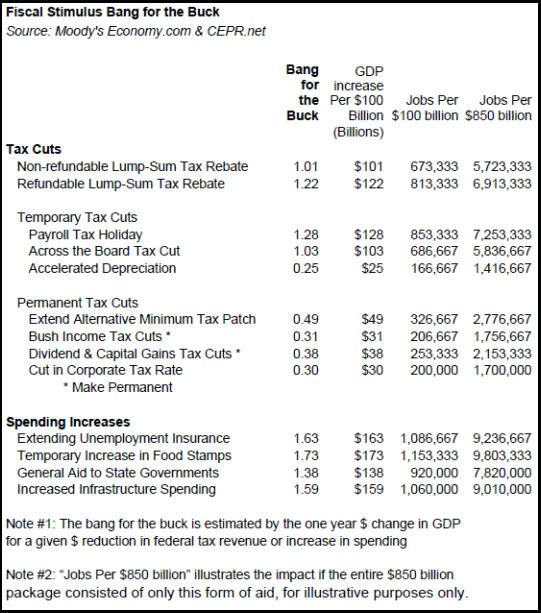
The above image, created by Paul Rosenberg at Open Left, shows figures that combine data from Moody's Economy.com and Dean Baker's Center for Economic Policy and Research. It shows the return on investment for different stimulus options. The takeaway? Food stamps, unemployment benefits, and infrastructure investment put the most money back into the economy for every dollar spent on them. Tax cuts for corporations and the wealthy do the least. (A payroll tax holiday, which is essentially a tax break for poor people, isn't so bad.) Job creation maps similarly.
So when conservatives tell you that FDR's public investment programs made the depression worse and that we need to hold fast to the conservative economic principles that created the current mess, shoot them this link. Perhaps President Obama should use that snazzy new BlackBerry of his to email it to his Republican opponents in Congress. http://www.openleft.com/showDiary.do?diaryId=11354
In the video below, commonly asked questions regarding the stimulus package are answered in clear, easy to understand terms.
Solid cutting edge infrastructure has been the secret weapon of every successful country/kingdom/empire. Our (US) interstate highway system is one of relatively few key reasons for our success. Without it we wouldn't have been able to transport goods (metals during the war, food always) across our vast country quickly and efficiently. We took one giant step forward after WWII, and it was because we put building a national infrastructure for transportation, water, power and food as well as communications on a double-step fast track. We are still working with that infrastructure in all parts of the country today, and more places than you would think still run entirely on that old system.
It is my belief that it is time to close up the foreign lending shop for a while, hang out an 'Under Construction' sign and get to work re-working our workings! We have the information and technology, the manpower the money and most of all the WILL to remake our systems into more efficient, longer lasting, safer systems that will once again throw us headlong over the goal post of expectations just as we have done in the past.
Internet communications lends itself to working from home or local 'communal' office spaces, lends itself to fewer flights, fewer buildings spewing carbon, fewer drivers, fewer accidents. The technology noted above is only a fraction of what is available.
There are still going to be jobs to be done, but new and different jobs. There will still be things to be sold, but different things. Business will not come to an end, it will just change. I think this will lead to more businesses ending up in the hands of the small business owners, the local communities. Working, shopping and eating local.
I began this search as I was watching the automakers, GAO and UAW speaking to congress. Sen. Tom Carper made a comment, rather paid a compliment to, the automakers that set me back in my seat, furrowed my brow and finally elicited a rather loud vocal response directed at the TV screen. "We face the voters, and one of the questions that is sometimes on their minds is 'what have you done for me lately'. 'And I think you are all going through a little bit of that lately too in terms of what have you done for us lately in terms of productivity..., ...bringing down the labor costs, ...what have you done for us in terms of improving quality, ...and in terms of improving fuel efficiency?' I was about to applaud, I reached for my keyboard to look this senator up as I listened intently for reactions from the big three. What I in fact heard next caused my hopes to fall, and instead of reaching to look up the senator, I went in search of his donations. "You've actually, I think any fair minded person would say on every one of those fronts, you've done a lot! You've done a lot!"
Productivity - FAIL - Any gains in this area have happened outside the borders of the US. IE Mexico
Labor costs - FAIL - Each car is sold at a loss, the reason the UAW is at the table with you.
Quality - FAIL*FAIL - Double failing grade here. With the exception of a couple of models produced only for European markets, American made cars continue to trail those from nearly every other country. Not only didn't you pass, you didn't even show up for the test.
Efficiency - FAIL*FAIL*FAIL - All of you spend millions every year to lobby congress in an attempt to stave off increasing CAFE standards. You spend millions more advertising and sponsoring large, inefficient cars, trucks, SUV's, Hummers etc and little to nothing making 'small and efficient' cool.
So naturally, I thought "he must be in the bag for the big three" and went to check donations. Not as easy as it seems. In reviewing the 'automobile manufacturers' political contributions (click here), I've had to do some adding of figures to get to a total of how much any 'one' company has contributed. The list of donors includes the usual suspects - Ford, GM, Chrysler, Nissan, Lexus, Mitsubishi and Honda. But along with those obvious are the less obvious, and suspicious. The number 5 contributor is 'Alliance of Automobile Manufactures'. What? Well, that must be for those that didn't contribute in their own name right? Wrong. A quick check of the members list for this 'alliance' finds familiar names, BMW, Mercedes, Mazda, Porsche and Volkswagen. Fine. But in addition to those names, we find (again) Chrysler, Ford, GM, Mitsubishi and Toyota! The total contributions for the Alliance were $21,850. With 10 members, that's $2185 each. Not much. Next comes a contributor called 'General Parts International', hmmm.. That's CarQuest Autoparts.... anyway. Daimlerchrysler is listed twice, once as mentioned and once as daimler chrysler. $6500 and $5650 contributed for a total $12150. Another name not expected is Badenoch LLC. This is a research and development Co with an NAICS of industrial design services. Yeah, that fits in with automobile manufacturers. Can you say creative accounting boys and girls?
I didn't find a lot of direct contributions to this senator from the auto industry, just some. I went back to his bio and it hit me. Mr. Carper is a senator from Delaware. The corporation capital of the country. ( I was going to say world, but that's just not so anymore, is it?)
I don't know a lot about this senator, might he have been calming the waters before dive bombing? His remarks were next directed to Mark Zandi, thanking him for previously providing what he calls a 'bang for the buck' reports, and asks for his opinion on the biggest bang for the buck here. Zandi says the government should provide aid, there is no choice. The cost of ensuring that the automakers don't go into bankruptcy in the next 3-4 years is going to cost more than $34 billion. He gave a range of $75-125 billion. Per Zandi, this is the total number taxpayers will be on the hook for, that includes hart (he was hard to understand here, could be 'our' 'art' or some other acronym) money, sec136 money... Zandi goes on to say that if they (the automakers) stick to the script, they will come out very viable companies. The problem according to Zandi is that sticking to the script outside of bankruptcy is going to be very, very difficult. Mentioning stakeholders, creditors, the UAW, suppliers and dealers all to deal with. So plan on them not sticking to the script. Zandi says allocate $34 billion for them but not all at once. GM wants $10bil to get them through to March 31st. Chrysler needs $7bil. Ford doesn't need anything. Zandi would give them this much of the $34bil to avoid any bankruptcy through Mar31. He agrees with a board for oversight, and especially the idea of a single person in the short term to streamline and expedite the recovery plan. At the Mar31 deadline, benchmarks must have been met to receive the next round of funding. He also suggests the companies use the time between now and then to prepare for bankruptcy. He concludes by insisting everyone stick to the idea that 'this is it'.
Carper follows the comments by Zandi with a single question about how to ensure a reasonable return to the taxpayers in order to take on the risk, which is answered by one witness with no followup questions. Carper then goes on to say that he doesn't think the automakers are getting enough credit for what they have already done! He thinks these 3 companies 'have positioned themselves to make a go it' within a couple of years. ... Ford has been in operation since 1903, General motors since 1908 and Chrysler since 1925. And they've positioned themselves over the past couple of years to 'make a go of it'? Oh really!
The GM balance sheet for the past 3 years stacks up like this: Net tangible assets (assets-liabilities including stock value) '05 $10,258,000 '06 ($6,559,000) '07 ($38,160,000) http://finance.yahoo.com/q/bs?s=GM&annual
Ford comes up like this '05 $7,497,000 '06 ($40,236,000) '07 $3,559,000 http://finance.yahoo.com/q/bs?s=f&annual
and Chrysler (Daimler AG, DAI) like this '05 $37,162,919 '06 $41,862,752 and '07 $48,646,941 (keeping in mind a majority of this company's business is outside the US) http://finance.yahoo.com/q/bs?s=dai&annual
It's fun to note that when I went to the chryslerllc.com website, the splash pages says this (and only this)
"It's not a bailout to keep us from failing. It's a loan to help us succeed. We are investing in the creation of new technologies for more environmentally responsible vehicles, reduced emission vehicles and emission free electric vehicles. As early as 2010 our exciting lineup of vehicles will offer an electric drive system. With a link to read more about their plan for a successful future, to learn more about their ENVI vehicles and a link to watch a video so that you may "See why you should care about the US auto industry". But I digress.
Senator Carper, your remarks today weren't in keeping with reality. Not only have these 3 companies had the time and experience to 'make a go of it' without any help, they haven't held to the 'free market' diatribe and they haven't performed in their own shareholder's best interests, much less the best interests of their employees or their customers. They've asked for and been given - repeatedly - tax breaks, incentives, grants and loans all with the promise of 'new technology', 'more efficient vehicles' and 'world class quality and safety'. These three automakers together make up the number 2 position in the world for sales http://en.wikipedia.org/wiki/Automaker, while being last in the world for quality, efficiency and safety. What in the world were you thinking with this thinly veiled attempt at questioning that was, in fact, 7 minutes of undeserved compliments and praise?
I've thought about it a lot. It sure does seem to me there are far more and better reasons to consider it than were put forward to actually complete the deed with Clinton. Nancy Pelosi insists we need to put forward proof of a crime. Since I'm not an attorney, and in the past things I've felt sure were crimes turned out not to be (wow, is that frustrating), I began looking for other more qualified information.
As I'm sure you can imagine, everyone has an opinion on the matter. Some seemingly qualified sources, some... not so much, but compelling none the less. I've read or listened to or watched opinions ranging from dark cultish ritual based conspiracies to ... well, only slightly less dark conspiracies. I click, read, listen, watch and repeat. Possibly, in the back of my TVgen mind, I think some 'Chuck' like answer will come over me and everything will become clear.
Below is a playlist, a collection of some of the video I've viewed and considered relevant to my search somehow. A few of them may seem off key, but in some strange way it relates to my thoughts and feelings about impeaching the president.
Also, click below to review some of the articles I've reviewed. There are quite a few listed here, so don't hurt yourself. The top listings under 'impeach' are the goal, but feel free to browse the full list.
"McCain's hoping to use gas prices as a wedge issue to win the election. That's why it's so critical that we keep spreading the message that McCain's been heavily influenced by the oil companies.When people think of Bush, they think 'oil,' but that's not true of McCain yet—even though his energy policy is almost identical to Bush's and his campaign is literally run by oil lobbyists! Check out this video from our friends at Progressive Accountability. Once you've watched, pass it on! And then please consider a donation (below) to help us spread the word."
MoveOn.org Political Action: Democracy in Action
Below is are a few things I've read on the matter:
"The projections in the OCS access case indicate that access to the Pacific, Atlantic, and eastern Gulf regions would not have a significant impact on domestic crude oil and natural gas production or prices before 2030. Leasing would begin no sooner than 2012, and production would not be expected to start before 2017. Total domestic production of crude oil from 2012 through 2030 in the OCS access case is projected to be 1.6 percent higher than in the reference case, and 3 percent higher in 2030 alone, at 5.6 million barrels per day. For the lower 48 OCS, annual crude oil production in 2030 is projected to be 7 percent higher—2.4 million barrels per day in the OCS access case compared with 2.2 million barrels per day in the reference case (Figure 20). Because oil prices are determined on the international market, however, any impact on average wellhead prices is expected to be insignificant." http://www.eia.doe.gov/oiaf/aeo/otheranalysis/ongr.html
Mccain's campaign also says it will do no good; http://thinkprogress.org/2008/06/18/top-mccain-adviser-offshore-drilling-will-have-no-immediate-effect-on-gas-prices/
No expert will back the BushCain claim; http://www.huffingtonpost.com/2008/06/23/impossible-finding-expert_n_108692.html
They are relying on skewed polling data based on biased questions to proclaim more Americans are for drilling: http://solveclimate.com/blog/20080728/poll-truth-clean-energy-solutions-topple-drilling and http://wilderness.org/Library/Documents/upload/BRS-Omnibus-Poll_07-22-08.pdf
The Saudi's will pump more this year at our President's request than the entire drilling venture would contribute; http://gristmill.grist.org/story/2008/6/24/151852/447
And here's why they are so under informed; http://gristmill.grist.org/story/2008/6/25/10526/4230.
The simple reality is, drilling just will never, ever do what McCain and Bush think it will.
Here's why
http://www.theseminal.com/2008/06/18/drilling-is-a-fraud/
John McCain's Connection to Big Oil & The Enron Loopholehttp://www.youtube.com/watch?v=AdRbuUQNcxw
and http://gristmill.grist.org/story/2008/6/30/62830/1353
On MSNBC Live, Andrea Mitchell discussed Sen. John McCain's call to end the moratorium on offshore oil drilling with RNC deputy chairman Frank Donatelli, but did not mention that Donatelli was a registered lobbyist for energy sector clients ExxonMobil and Dominion Resources before joining the RNC. Click here to read more... http://mediamatters.org/items/200806180004
Suppose we raised average fuel efficiency to 40 MPG by 2030; this would save us more than 5 million barrels of oil per day, 25 times as much as we would get from Senator McCain's offshore drilling. Since many cars sold today already get more than 40 MPG, this is hardly an unrealistic target. Americans drove 11 billion fewer miles in '07 http://www.dot.gov/affairs/fhwa1108.htm.
Wherever we set our targets, the simple arithmetic shows that it is far easier to have an impact on oil markets through conservation than drilling in environmentally sensitive areas.
http://www.truthout.org/article/john-mccain-wants-drill-your-toilet
An EPA email that the white house refused to open, in an attempt to stall enacting the measures recommended within, found danger to human health caused by climate change. http://www.washingtonpost.com/wp-dyn/content/article/2008/07/24/AR2008072403423.html?hpid=sec-health
and http://www.treehugger.com/files/2008/06/white-house-wont-open-emails-pt2.php
Robert Kaufmann, director of the Center for Energy and Environmental Studies at Boston University, talks about the realities of offshore oil drilling, including how much oil there might be, when it would be available and what the consequences could be. http://www.npr.org/templates/story/story.php?storyId=92677194
Alaska's longtime senator, Republican Ted Stevens, has been indicted by a federal grand jury as part of a continuing investigation of corruption in Alaska politics. The indictment accuses Stevens of filing false disclosure reports about his personal finances for 2001-2006, concealing more than $250,000 in home renovations that a private company paid for. That company was VECO, a multinational oil services company that has been at the center of the feds' corruption investigation since it was made public in 2007. http://www.opensecrets.org/news/2008/07/feds-indict-alaska-sen-stevens.html
Testimony before Senate by Michael W Masters:
I have been successfully managing a long-short equity hedge fund for over 12 years and I have extensive contacts on Wall Street and within the hedge fund community. Itʼs important that you know that I am not currently involved in trading the commodities futures markets. I am not representing any corporate, financial, or lobby organizations. I am speaking with you today as a concerned citizen whose professional background has given me insight into a situation that I believe is negatively affecting the U.S. economy.While some in my profession might be disappointed that I am presenting this testimony to Congress, I feel that it is the right thing to do.You have asked the question “Are Institutional Investors contributing to food and energy price inflation?” And my unequivocal answer is “YES.” http://hsgac.senate.gov/public/_files/052008Masters.pdf
NEW YORK (CNNMoney.com) -- The government charged an oil trading firm Thursday with manipulating oil prices in the first complaint to be announced since the regulators began a new investigation into wrongdoings in the energy markets. http://money.cnn.com/2008/07/24/markets/cftc/H. R. 6604
Bill to amend the Commodity Exchange Act to bring greater transparency and accountability to commodity markets, and for other purposes http://www.govtrack.us/congress/billtext.xpd?bill=h110-6604
Please join more than one million others who know it will take all of us coming together to solve the climate crisis. http://www.wecansolveit.org/page/s/challengeremix
FBI Holds 406 on Mortgage Fraud - BBC News
The FBI says it has arrested 406 property market players as part of a crackdown on alleged mortgage frauds worth an estimated $1bn (£500m).
The arrests include housing developers, estate agents and mortgage brokers. Some of cases involve the alleged use of false employment records or the inflation of property values.
Nice progress, but still no mention of the appraisers. Those inflated property values wouldn't have made it down the pipeline without their complicity.
Resolving the mortgage fiasco is going impossibly long, and while words like 'fraud' and 'scam' have been floating since the beginning, they are really only now making big news. Unfortunately they still haven't much referenced the collusion between the lenders and appraisers, and in taking it a step further, the local assessor officials. I began blogging at the beginning of this mess, Not Rocket Science and Confessions of a Mortgage Broker, trying to illuminate the 'Big Picture' in my view regarding the chain of events and participants. Appraisers and local property assessors played a bigger role in my situation than has been discussed in any meaningful way, and as events unfold it becomes more and more clear that my situation mirrors the national situation pretty closely. That having been said, I do not suffer from a 'impending doom' adjustable mortgage, and I did manage to buy my properties before the effects of what was happening hit the actual prices.
I will blog more about my own story another day, for now I just want to re-state the chain of events as I see them:
The rest, as they say, is history. A huge number of other things contributed to our situation, had all of these things happened at any other time it may not have ended with the same result. We need to clearly identify the failings in the system and make adjustments. This is a very good example of how a 'Free Market' approach with no real oversight or regulation doesn't come close to being a good idea. Free market for razor blades and cabinet doors, sure, but lets get together on things that effect our country as a whole like lending, health, transportation, energy and lets not forget military.
How Fraud Fueled the Mortgage Crisis:
"Brokers pushed borrowers to lie, lenders misled and ratings agencies looked the other way.
The debate over what caused the mortgage mess and how best to fix it is now taking a sharp turn, as new problems surrounding liar's loans and payment-option mortgages reveal the pervasive fraud, lying and deceit that permeated the market at its height.
As loans made to borrowers with decent credit begin to fail at a surprisingly rapid rate, it's becoming clear that widespread fraud helped support the entire mortgage system - from borrowers who lied on their loans, to brokers who encouraged it, to lenders who misled some low income borrowers, to the many lenders, investors and ratings agencies that conveniently and deliberately looked the other way as profits rolled in."
"Despite its widespread role, fraud hasn't yet been at the forefront of proposed rescue plans, which center on refinancing people out of loans now resetting to higher rates. That may begin to change as the mortgage market continues a meltdown that seems to have no end. As fraud becomes a focus, the question of who did most of the lying and cheating will be crucial in deciding who deserves help in any housing rescue plan. "
"Others familiar with the mortgage industry contend that pervasive fraud was, indeed, a problem - on the lender's side. At the peak of the housing boom, they say, the nation's mortgage system was set up to promote and encourage outright fraud in order to close a loan - and everyone, from brokers to loan officers to Wall Street, looked the other way. Borrowers also were put into products like payment-option arms that were unsuitable - and lenders knew it. "They were pushed like Vioxx, with very little regard for their dangers," said Kathleen Keest, senior policy counsel with the Center for Responsible Lending, a research group that investigates predatory lending. "
"Patrick Madigan, an Iowa assistant attorney general who has investigated mortgage fraud, said it makes no sense to conclude that lenders are somehow victims. Madigan's office engineered a settlement two years ago with Ameriquest over its subprime practices, including high-pressure "boiler room" sales tactics. Regardless, Madigan said, there is a movement to "blame the borrower."
"There's a perception out there that there's this hapless lender who got duped by middle class and lower income subprime borrowers," Madigan said. "It's ridiculous. Our investigations have shown that most of the fraud happens at the suggestion and direction of the loan originator, who had significant financial incentives to close the loan, no matter what misconduct was required."
"Even if fraud has become a larger part of the mortgage meltdown picture than first realized, it's not simple to figure out who should take most of the blame. Many people point the finger at investors playing the market or homeowners who bought more expensive houses than they could afford - the "irresponsible" borrowers cited by both President George W. Bush and probable Republican nominee Sen. John McCain (R-Ariz.). "
"But the numbers don't exactly tell that story - which proves that much in this crisis taken as fact is poorly understood. That also makes a difference, when it comes to deciding whether it makes sense to bail out the market. At the request of The Washington Independent, the trade industry publication Inside Mortgage Finance in Bethesda, Md., ran some numbers and analyzed the resulting data.
Did most people simply buy big homes they couldn't afford? In 2007, 62 percent of all securitized Alt-A loans involved refinances, and 38 percent were for home purchases. In the subprime market, 64 percent were refinances and 36 percent, home purchases. The percentages were the same in 2006. Those borrowers may have been tapping equity for reasons as varied as fancy vacations to overdue medical bills, but the majority were not buying new homes.
Were they just trying to make a quick buck? Regarding investors versus homeowners, in 2007, about 5 percent of all securitized subprime loans and 14 percent of Alt-A loans were reported as investor loans. That compares to 5 percent of subprime loans and 13 percent of Alt-A loans in 2006. These numbers don't include second homes, so the percentages are probably higher, but not significantly so.
Then there's the question of who really lied on the liar's loans. Madigan, the Iowa assistant attorney general, cites repeated cases where borrowers were encouraged by brokers to suddenly create businesses in their basements, like day care centers, to boost their incomes. If they questioned it, brokers would say that lenders required it, or not to worry. Still, borrowers signed on the bottom line, some knowing the information was false. Consider this borrower's account in the San Francisco Chronicle of a sales conversation with a broker:
" He didn't say anything illegal out loud," she said. "He didn't say 'lie,' he just made a strong suggestion. He said, 'If you made $60,000, we could get you into the lowest interest level of this loan; did you make that much?' I said, 'Um, yes, about that much.' He went clickety clack on his computer and said, 'Are you sure you don't remember any more income, like alimony or consultancies, because if you made $80,000, we could get you into a better loan with a lower interest rate and no prepayment penalty.' It was such a big differential that I felt like I had to lie, I'm lying already so what the heck. I said, 'Come to think of it, you're right, I did have another job that I forgot about.'"
" Countrywide, for example, had a loan program called "Fast and Easy" that required no pay stubs, tax forms or employment verification. The FBI investigation is finding extensive fraud on loans across the board at Countrywide that didn't require full documentation, The Wall Street Journal reported. "

Rep Nydia Velazquez returns for a moment to comment on Mr. Young's statements, taking the time to remind him that when he had the opportunity to vote against price gouging he voted no, and when he had a chance to vote about long term alternative energy and conservation he also voted no. After refocusing our attention on the matter, HR5819, and thanking the members who contributed to it's efforts Rep. Velazquez yields back her remaining time on the floor.
Rep. Boswell rises to address issues related to his proposed amendment with Rep. Sutton of Ohio. This amendment will steer monies from the SBIR and SBBT programs to areas that have (or will) lose jobs from closing factories and manufacturing plants. "These programs will help small business in these areas create new, high quality jobs in areas hard hit by pressures of globalization and current trade policies." He cites Maytag as an example, while the Newton economy has not yet recovered from this blow, part of the former Maytag building is in the process of being occupied by a new company that makes components for wind turbines, he says.
"This is a step toward more energy, in response to the gentleman from Alaska. This amendment will help revitalize economies of communities like Newton and thousands of others across the United States."
The point I think, and it may be too 'un-political' to state it quite so obviously, Is that A) The oil and other major fossil fuel companies have known of our predicament for quite some time, have known the direction the country and in fact the world has been taking over the past 2 decades with regards to oil and fossil fuel and alternative energies and have chosen to not move themselves in our direction. B) The time to defend the subsidies, special tax designations and research & development grants is long over. The public funding opportunities to these giant corporations, NOW to try and fund oil friendly technology, is very definitely over.
If a free market is what you want, then you have your answer. We want wind, solar, bio-diesel from non-food crops and anything else you can think of besides oil. We were willing to fund your research for new, clean technologies to locate, pump, refine and deliver oil. In 20 years and countless millions (billions?) of public dollars there is still not a clean ,safe enough plan to convince us that destroying a unique and priceless wilderness is worth it. We are no longer willing to hear your pleas in this area, there are companies waiting in line to take our money for a product we approve of. They will provide new jobs for our workers, new power for our cities and a new pride for our country.
I'd like to provide another example to the Representative from Alaska:
Wind Power Produces 123% of Residential Energy Demand in Rock Port, Missouri
Yes, that means the town produces ALL of it's required power AND sells 23% of it back at a profit.
I don't say this often, but I'm in agreement with a republican today. Senator Judd Gregg spoke today on the Mortgage Crisis package. He is against helping out the lenders who targeted consumers for adjustable rate loans, who looked the other way when appraisers fudged the value of the homes they backed. He is against helping builders and investors who speculated on the bubble and lost. The homes are still there, they will be purchased and loans will be issued. Business will go on, take your losses. The party that cannot help themselves in this situation, the foundation of the economy, (I hate saying this) is the consumer. You know, the people. His concern with who will be buying the debt (you know, our new creditors) is my concern as well.
"Don't blame us," oil industry chiefs told a skeptical Congress.
Top executives of the country's five biggest oil companies said Tuesday they know record fuel prices are hurting people, but they argued it's not their fault and their huge profits are in line with other industries.
This is right up there with Mccain's "I don't care about the people and I don't know much about the economy but have Mr Greenspan's book", and Cheney's 'who care's what the American people think'.... Huh, I wonder how THAT Happened?!
Dean Baker Financial Meltdown: "But the cover stories don't hold water. We can keep the banks running without bailing out the incredibly rich people who drove them to ruin. England showed us the way earlier this year with its takeover of Northern Rock, a major bank that got itself in trouble with bad mortgage debt.
We can also help homeowners without bailing out the banks. The rescue proposals currently on the table would have the government buy or guarantee mortgages on homes that are still hugely overpriced. These proposals could give hundreds of billions of dollars to the banks, while providing little help to homeowners. Most would still be paying far more on their mortgage, property taxes and insurance than they would to rent a comparable home. Furthermore, the bailout conditions virtually guarantee they will never have a dime in equity."
During the Great Depression, a massive bailout of savings&loans was made. It didn't help. Some are adamant this action actually caused the depression. This was less than 100 years ago, how can we be about to make the same mistake? I get my thoughts on this from vague history class memories, below is a link to someone with a tad richer credentials:
Lessons from Bailout History
Joseph R Mason
Associate Professor of Finance and LeBow Research Fellow, Drexel University
LeBow College of Business, Senior Fellow at the Wharton School, and Financial
Industry Consultant, Criterion Economics, LLC. Contact information:
joseph.r.mason@gmail.com

Today I'm listening to Sen. Jon Kyl debate in the Senate over the budget. He mentions that the government should be working for us, not against us. I would like to remind the Senator that 'Our' government, while it has taken a turn for the worse due to corporate manipulation, is still 'Our' government. Of By and For the people. Shame on him for trying to deepen the illusion that it's "Us against Them". There is no dictator standing at the helm here, there is no brutish force that will arrive at my door for tendering this admonishment.
You offer this statement in your argument regarding what you call "paying for tax cuts". You say that it does no service to Americans to cut a tax here and raise another there to 'pay for it'. I am glad that you that you have been able to hold on to this one ideal that all Americans are created equal but perhaps I should remind you that not all Americans have remained equal. You and I both know that the tax cut "Here" will be from middle and lower income 'Americans', just as well as we both know that the taxes raised "There" will be from upper-middle and high income 'Americans'.
In your picked and parceled ideal world, everyone would keep their own money and let the blocks fall where they may, is that it? I'm sure it sounds good from up there, in Short Sightedville. You and your friends have the money to send your children to private schools, hire private security for your homes and the very best doctors. You can build tall sturdy walls around your village to help protect yourselves...thinking maybe you have seen this movie before?
The thing of it is the rest of us, the majority of us, still hold on to that one first Ideal. Of By and For. We want everyone to chip in to secure our neighborhoods, to inspect our food supply, to protect children and the elderly. Everyone benefits from educated citizens, stop sending jobs overseas and chip in to educate us! Everyone suffers when poor education leads to low employment that leads to low personal morale that leads to crimes of desperation and frustration, chip in for parenting education, counseling and school-to-work programs. Corporations don't make money without People. If people are afraid, unprepared and sick, if roads are unsafe and mothers worry about food and toys that may kill their children they are not going to pay for the goods and services that keep your corporation in business. I could go on, but you must get the point by now. Our government IS us, we don't like ourselves very much right now but we are working on it. Our government has the best plan to date that realizes and works WITH the fact that this remains a dog eat dog world, it allows for the will of the many to outweigh the will of the few without oppression and violence, where any person can speak their mind and hope to convince others.
Sir, you are a United States Senator speaking from the floor of the US Senate building, you ARE government. If you see a division between the government and the people then You sir, and others like you, are the divisive factor. If every one of you leading OUR government would take the blinders off and act each and every time in the interest of the people, remember that you in fact ARE the people instead of acting in your own personal interest, things just might go a little more smoothly. Stop creating the divisiveness you rail against.
The money Of the People spent justly By the People For the People's benefit.

The bill in question will end the subsidies to oil companies, paid for by our taxes. The companies in question made all time profits records over the past 10 years, with the past 2 years topping them all. You know, the same time period brought a $.75 per gallon increase in gas costs to you and I. Exxon reported $40.6 Billion in profits, the largest annual profit by a US company. After these several hours not one opponent has addressed the need for these companies to remain subsidised. Someone mentioned something about the oil companies providing jobs, but I believe it was in a question to the opponent about how they are making the claim when a growing number of their jobs are being filled outside the US.
What it comes down to is that oil is at an all time high, the rate of increase in cost to end users is itself increasing. During the oil friendly republican years in Washington, these companies were offered tax incentives and subsidies, judging by their current profits the program worked, the companies are solidly on their feet and it is not only time the subsidies end, but I think it is time for the companies to say thank you. I think more money should be invested by them for education in the united states to fill their employee needs. Taking it a step further, if their threat is the loss of jobs in the us, then imposing strict high taxes for out sourcing should be enacted. (this is my stance for all American companies, not just oil)
When a company impacts the entire country the way big oil does, and in fact accepts special status from the federal government in the form of subsidies based on the fact that the company has such an impact, they also bear the responsibility to act in the best interest of the country first and foremost. It must also be understood and accepted that in these situations the good of the country is in fact the good of the stockholders, resulting in no conflict.
The price of oil will do nothing but continue to rise, the longer we wait to invest in other energy sources the more it will ultimately cost us. These oil companies are in the unique position to catapult the US ahead of the world in advances in green renewable energy technology, to place America once again ahead of the pack and make us a leader in what is indisputably the direction the entire world is taking. They simply need to recall their lobbyists on this matter, stop the flow of money, rhetoric and threats and simply let the subsidies lapse. They will still be largest profit makers in the country, making more money than most other countries in the world. And in addition to that they can regain the trust of the American people.
One of the main arguments I have heard from opponents aside from the damage it would do to the companies (never named, inferred small American business, but what small oil company is being affected by this? Are there even any mom and pop oil companies?) is that there is a section that will allow Venezuela to exempt. Actually they (opponents) complain that "Hugo Chavez" will be exempt, transparent attempt to inflame the issue. The details of the section are clear, and our negotiations and agreements with that country fall under exemption, and the reasons make sense. I believe we went to great lengths to develop a relationship with that country in an attempt to shift our oil dollars outside the middle east. And don't be confused, much of the major oil company's money has been invested in that country also, they are the real steam behind this argument.
The other main arugument was that this would cause an increase in the cost of gas to consumers at a time when they can hardly afford it due to global economics and local slumps. I as well as the proponents in the house again reminded everyone we are talking about companies that are posting tens of BILLIONS of dollars in profits (the number resulting after excluding the cost of running the business such as salaries). They took no time in reminding them they are not suggesting taking privatly earned profits from the company, but recalling publicly provided subsidies. They fairly shouted at them that consumers paying record prices for gas during an economic "slump" while also paying out subsidies to the same company was perverse.
President Bush in 2005 said "I will tell you with $55 a barrel oil we don't need incentives to oil and gas companies to explore" We are almost 100% above that price today.
HR 5351 extends tax incentives for alternative energy and energy efficiency investments.
Please contact your Representative www.house.gov/house/MemberWWW.shtml
and let them know your feelings on this.
By Matthew Bigg
ATLANTA (Reuters) - "The inability of John Edwards to gain traction in his bid for the U.S. Democratic presidential nomination indicates that fighting poverty in America has limited appeal for voters.
Edwards told audiences it was 'the issue of my life.' But he dropped out of the race on Wednesday because too few responded to his anger at inequality, his heart-rending stories of suffering and his passion about combating corporate greed."
I've sat staring at the walls for about 10 minutes now trying to compose my thoughts on this subject. There is so much I don't know about the impact this or that strategy may have, all that I 'do' have to draw on is the experience that is my life and the scant amount of common sense allotted me. I have fleeting thoughts about the direness of the situation, they tend toward "we've been living in the bubble, we were fine before the bubble, the bubble was great while it lasted". I back pedal toward.. and here is where it gets fuzzy...toward what? Staying the course? Maintain the status quo? No...common sense interjects, values are too high, quality is too low. Compensation for value is out of whack. Over consumption and waste are evidence. There needs to be a stimulus package, but not only for the reasons of impending doom, but for the morale of the nation after what feels like a 10 year beat down. But I believe it should be targeted toward the food stamp and UE benefits, the individual compensations and small business targeted tax relief and backing start up costs for small business only. Large multi-national corporations that have benefited from the 'Bubble' should take the bonus with thanks and get back to business as usual, as in 'Pre-Bubble' usual.
NPR: Senate Democrats Have Plans for Stimulus Package
Q&A: What's in the Tentative Stimulus Deal?
by Heidi Glenn
The 380,000-plus-word database presented here allows, for the first time, the Iraq-related public pronouncements of top Bush administration officials to be tracked on a day-by-day basis against their private assessments and the actual “ground truth” as it is now known. Throughout the database, passages containing false statements by the top Bush administration officials are highlighted in yellow. The 935 false statements in the database may also be accessed by selecting the “False Statements” option from the “Subject” pull-down menu and may be displayed within selected date ranges using the selection tool below. Searches may also be limited by person or subject, or both, by using the appropriate selections from the pull-down menus.


 Posts
All Comments
Posts
All Comments