Newt Gingrich claims that “more people have been put on food stamps by Barack Obama than any president in American history.” He’s wrong. More were added under Bush than under Obama, according to the most recent figures.


Message Force Multiplier


Israel has a population of approximately 7.8 million, or a million fewer than the state of New Jersey.
It is among the world's most affluent nations, with a per capita income similar to that of the European Union.[1] Israel's unemployment rate of 5.6% is much better than America's 9.1%,[2] and Israel's net trade, earnings, and payments is ranked 48th in the world while the US sits at a dismal 198th.[3]
Yet Israel receives approximately 10% of America's foreign aid budget every year.

Israel's cost to American taxpayers has remained high since Stauffer's 2003 study.
The US currently gives Israel an average of $3 billion a year in military aid, under an agreement signed by the Bush administration to transfer $30 billion to Israel over ten years, starting in 2009.
So now we are back to the question of why America continues to pour money into a state that commits daily human rights violations, defies US strategic interests, provokes rage and resentment among billions of people, competes with and crowds out US interests using technology subsidized by US taxpayers, and sells America's military secrets to its enemies.
AIPAC, the American Israel Public Affairs Committee, is consistently ranked in the top two most powerful lobbies in Washington. And it is only one arm of the much larger, multi-faceted, and well-financed Israel lobby.
Please, read the entire article here: http://ifamericansknew.org/stats/cost.html

The gist of the site is not to sway you one way or the other, merely to inform you as the taxpayers providing this money of the reality of the situation so that you can make an informed decision. There is an excellent video here: http://youtu.be/ziSTY408h6k that explains the problem with the information you are not getting.
President Obama raised more money from more contributors without taking any PAC funds. I believe that means more votes. The top contributors to his campaign were schools and tech companies while Former Governor of Massachusetts Mitt Romney's top contributors list reads like a who's who from the banking scandal that plunged the globe into recession. Speaking of the great state of Massachusetts, it was the 4th top state contributor to a campaign, but it wasn't Romney's.
The sectors that topped the list of contributors to Mitt Romney's campaign? Agribiz, construction, defense, energy (oil) and finance/insurance.


by Bob Fitrakis - Co-counsel in the King Lincoln case.
A new filing in the King Lincoln Bronzeville v. Blackwell case includes a copy of the Ohio Secretary of State election production system configuration that was in use in Ohio's 2004 presidential election when there was a sudden and unexpected shift in votes for George W. Bush. The filing also includes the revealing deposition of the late Michael Connell. Connell served as the IT guru for the Bush family and Karl Rove. Connell ran the private IT firm GovTech that created the controversial system that transferred Ohio's vote count late on election night 2004 to a partisan Republican server site in Chattanooga, Tennessee owned by SmarTech. That is when the vote shift happened, not predicted by the exit polls, that led to Bush's unexpected victory. Connell died a month and a half after giving this deposition in a suspicious small plane crash. Read the rest of the story...
Time To Face The Reality Of Election Rigging
by Jonathan Simon
...There's a chilling reality taking shape here and we might as well fill out the picture. There is something known as the "red shift." It occurs when votecounts are more Republican (or more in favor of whatever candidate or ballot issue the Right supports) than the baselines--including exit polls, tracking polls, noncompetitive elections, and handcounts. Read on Here...
Did Mitt Romney Commit Voter Fraud?
By Stephanie Mencimer
...Romney and his wife, Ann, bought a $12.5 million home in La Jolla, California, in May 2008.... April 2009, the Romneys sold their home in Belmont, Massachusetts, for $3.5 million, and registered to vote from an address in the basement of an 8,000 square-foot Belmont manse owned by their son Tagg... May 2009 that the Romneys had made their primary residence a $10 million estate in New Hampshire... yet voted for Scott Brown in the 2010 Massachusetts special election. Read on Here...
Sylvestro and the New Hampshire Election
One man's private, sole source company programs 81% of the election in New Hampshire, 100% in Connecticut, almost all of Massachusetts and most of Vermont. Never before seen video of the under-the-radar elections contractor John Silvestro as he tangles with master security expert Harri Hursti. Watch the video Here...

"In Summer 2009, something stirred in America. After Barack Obama and a Democratic congress swept to power promising a new era of hope and change, out of nowhere the emergence of a citizens protest movement called the Tea Party threatened to derail their agenda. Was this uprising the epitome of grassroots democracy? Or was it, as some said, an example of “astroturfing” - the creation of fake grassroots groups, designed to put corporate messages in the mouths of seemingly independent citizens?" LinkTV.org

Note that despite the Tea Party Mission Statement citing fiscal responsibility as being at the top of their list of core values, the above chart from opensecrets.org shows the 2010 Tea Party USA PAC spending well exceeds funds raised.

The Texas Tea Party had quite a larger income, but not a dime is noted as going to a single actual candidate.
NRDC - 2/2/11 - Press contact: Elizabeth Heyd, 202-289-2424, eheyd at nrdc.org
"Americans Pick Health of Families Over More Pollution From Corporations: 77 Percent of Americans -- Including 61 Percent of Republicans -- Say: "Congress Should Let the EPA Do Its Job."
"WASHINGTON (February 2, 2011) -- More than three out of four Americans (77 percent) -- including a clear majority of Republicans (61 percent) -- oppose efforts in Congress to block Clean Air Act updates for carbon, smog and other pollution, according to a national opinion survey by Opinion Research Corporation (ORC) International for the Natural Resources Defense Council (NRDC). The new poll is being released today as a major House/Senate bill is introduced in Congress to kill the authority of the Environmental Protection Agency (EPA) to continue its work on updating key anti-pollution safeguards."
Read the rest of this press release at NRDC.org
Bush's Schrodinger's Email: - NY Times 1/25/08
"The White House in December refused to accept the Environmental Protection Agency’s conclusion that greenhouse gases are pollutants that must be controlled, telling agency officials that an e-mail message containing the document would not be opened, senior E.P.A. officials said last week."
Controversial Bush-Era EPA E-mail Released: - CBSNews 10/13/09
"(AP) A controversial e-mail message buried by the Bush administration because of its conclusions on global warming surfaced Tuesday, nearly two years after it was first sent to the White House and never opened.The e-mail and the 28-page document attached to it, released Tuesday by the Environmental Protection Agency, show that back in December of 2007 the agency concluded that six gases linked to global warming pose dangers to public welfare, and wanted to take steps to regulate their release from automobiles and the burning of gasoline."
Hooking Your Toilet to the Kitchen Tap: -Sierra Club 6/11/09
"Atlanta, GA -- In most states, it's illegal to connect your toilet so that it drains through your tap. But on a larger scale, the Bush EPA is prepared to declare that this is, in effect, allowed under the Clean Water Act. At least that's what the agency told a conference of water managers here will be permitted by a new agency rule."
EPA Plans to Loosen Air-quality Rules near National Parks: - 5/16/08
"Call us crazy, but rewriting the Clean Air Act to ease the way for new coal plants near national parks seems to fly in the face of that whole 'clean air' thing. But sure enough, the U.S. EPA plans to make a change allowing the government to calculate the average annual emissions of power plants near parks and wilderness areas, instead of tracking (and potentially punishing) the spikes in pollution spewed during peak energy times. 'It's like if you're pulled over by a cop for going 75 miles per hour in a 55 miles-per-hour zone, and you say, 'If you look at how I've driven all year, I've averaged 55 miles per hour,'' explains Mark Wenzler of the National Parks Conservation Association."
Click on the label 'EPA' below to view all my posts on the subject.
"To be clear, I don’t buy the assumptions or the vocabulary of the “free marketers” one bit and they don’t, either. If they did, you’d hear more about compensation for teachers, a consideration that is as Econ 101 as it gets. Their real goal is to bust the unions, which they see as dangerous bastions of liberal thinking, and to transform the education system into a training system that will produce reliable worker bees for the engines of commerce. Quiet worker bees who don’t rock the boat."
"Here’s the problem. Take any senior leader in any successful company in America. Ask him (let’s assume it’s a him for obvious reasons) if he believes he deserves his very high salary, and if so, why. My guess is that he’ll think he does important work and that the more valuable you are, the more compensation you will and should command. Ask him if the company could get somebody to do his job for half as much money and he’ll probably say sure, but you get what you pay for. Ask if he believes that these principles hold for others in his organization and he’ll likely talk about the importance of attracting and retaining top talent (odds are he’ll use those exact words, in fact) and he will probably allow that if his top competitor pays better that his company will be at a disadvantage.
This is Economics 101, first day of class."
Read the rest of this article at Scholars & Rogues.
Where we Stand - Education in America - PBS
Waiting on Superman - Variety
The Story of American Public Education - PBS
US Education Dashboard - ED.GOV
Start with the obvious: There are no cuts to America's bloated military budget, which was somewhere north of $660 billion in 2010, more than the rest of the world's defense spending combined. And there are no cuts to the sprawling, opaque Department of Homeland Security, which costs more than $50 billion a year. In maintaining global empire and expanding the security state, every dollar is sacred.
There are also no cuts to fossil-fuel or corn-ethanol subsidies. No corporate contributor to the Republican Party will find anything to fear. The bill might as well be called the Thumbing Liberals In the Eye Act of 2011. It's a laundry list of targets conservatives have been after for decades, most of which will make no appreciable difference to the nation's fiscal health.
Here are a few proposed cuts that might be of particular interest to Grist readers:
Energy Star Program: $52 million a year.
Intercity and High Speed Rail Grants: $2.5 billion a year.
DOE Weatherization Grants to States: $530 million a year.
Amtrak Subsidies: $1.565 billion a year. (There are no cuts to highway subsidies, of course.)
Technology Innovation Program: $70 million a year. (Wait, I thought support for innovation was "post-partisan"!)
Applied Research at Department of Energy: $1.27 billion a year.New Starts Transit: $2 billion a year.
Subsidies to the United Nations Intergovernmental Panel on Climate Change: $12.5 million a year.
Title X Family Planning: $318 million a year.
Appalachian Regional Commission: $76 million a year. (Why do we need this? They already have coal mines there!)
FreedomCAR and Fuel Partnership: $200 million a year.
Subsidy for Washington Metropolitan Area Transit Authority: $150 million a year.
National Organic Certification Cost-Share Program: $56.2 million a year.
"We the People are the first three words of the Preamble to the Constitution; and from its adoption until the Robber Baron Era in the late nineteenth century, people meant human beings. In the 1886 Santa Clara case, however, the court reporter of the Supreme Court proclaimed in a “headnote”—a summary or statement added at the top of the court decision, which is separate from the decision and has no legal force whatsoever—that the word person in law and, particularly, in the Constitution, meant both humans and corporations.
Thus began in a big way (it actually started a half century earlier in a much smaller way with a case involving Dartmouth University) the corruption of American democracy and the shift, over the 125 years since then, to our modern corporate oligarchy."
"McCain-Feingold was a good bipartisan achievement by conservative senator John McCain and liberal senator Russ Feingold to limit the ability of corporations to interfere around the edges of campaigns."
"But the law offended the members of the economic elite in this country who call themselves “conservatives” and believe that they should be able to spend vast amounts of money to influence electoral and legislative outcomes."
"By having free-speech rights equal with people, Stevens argued, corporations will actually harm the “competition among ideas” that the Framers envisioned when they wrote the First Amendment:
“[A] corporation...should have as its objective the conduct of business activities with a view to enhancing corporate profit and shareholder gain.” In a state election...the interests of nonresident corporations may be fundamentally adverse to the interests of local voters. Consequently, when corporations grab up the prime broadcasting slots on the eve of an election, they can flood the market with advocacy that bears little or no correlation to the ideas of natural persons or to any broader notion of the public good. The opinions of real people may be marginalized."
Read the rest of this '1st in a series' HERE.
(EDIT)
The original version of this post included a banner from wakeupwallmart .com. The links used for that banner now point to a UFCW union webpage where they are promising to make things better. I'm not sure if wakeupwallmart was always a part of this union website, but I do know they have removed all of the pages from the wakeup site. Perhaps under pressure from the giant one? wakeupwalmart com banners ticker ticker150x200 html

The US Government in the Health Insurance business? The arguments, when you can get down to those that are A) Real and B) Relevant, are varied. I've had a bit of difficulty drilling down to this list but think I've come to the gist of it. In part one we discussed the costs, in part two we discussed control and in part three we will review why American Healthcare when viewed in the long term is too all encompassing an American Problem we can no longer ignore.
Since this is America and short of revolution nothing, not even morals, weighs in heavier than money we will take another broader look at the economic impact our current health care system and it's lack of complete coverage for all Americans takes on us.
When your representative speaks to you about the cost of a plan, and how it will be paid for, there are always the stipulations that can be quantified either in costs or savings, but there are too those that cannot. The actual dollar amount of savings by providing a person basic health care (prevention and education) thereby avoiding high cost end stage treatments will not be fully addressed by the agencies responsible for providing data. Neither will the increased tax and wage dollars gained by small businesses opening that couldn't without the reform because the cost of employee health care put opening out of reach. No one will try to tally the money gained from increased productivity either, healthy people are happy and more productive, clearer thinking and dependable.
Why CBO Cannot Calculate the Savings That Will Come With Healthcare Reform -
"The CBO’s track record in predicting the effects of health legislation is abysmal,” observes Bruce Vladeck, the man who ran Medicare while serving as administrator of the Health Care Financing Administration from 1993 to 2997. “Over the last two decades, the CBO has routinely overestimated the costs of expanded government health care benefits,” Vladeck adds, “and underestimated the savings from program changes designed to reduce expenditures.”
In the early eighties, Congress adjusted the way in which Medicare would pay hospitals. Under the new Medicare woudl pay a fixed amount per admission based upon primary medical condition. “CBO predicted that by 1986 total spending would be $60 billion. Actual spending in 1986 was $49 billion.”
That’s $11 billion on 60. That’s wrong by more than 18%,” .Ricciardelli observes.
In the second case, Gabel “found that savings from the Balanced Budget Act of 1997, which changed the way skilled nursing facilities and home health services were reimbursed under Medicare, turned out to be 50 percent greater in 1998 and 113 percent greater in 1999 than the budget office forecast.”
“Wrong by 50% and by 113%.”
The Institute for Healthcare Improvement (IHI) has identified some 70 U.S. communities that already have managed to do what progressives claim health care reform can do: change how care is delivered so that it is both less expensive and more effective. As I reported here, IHI spotlighted 10 of those communities at a recent conference where IHI president Don Berwick stressed: “We don’t have to ration needed care. We don’t have to raise taxes” for the middle-class or the upper-middle class. Structural changes in our health care system can ultimately provide the savings needed to pay for universal coverage. This is not a theory dreamed up by ivory-tower academic physicians. It is an idea that has been realized in some 70 communitites. Health Beat 2009
4 Hidden Costs of Healthcare
Health care is by far the most cartelized, anti-competitive big business in America. The market is crippled by a web of quotas, entry barriers, monopolistic licensing laws, and discount limits that wouldn't be tolerated in any other industry.
Health insurance: Low-dose competition
In most cities or regions, the health insurance market is dominated by one or two giant carriers, the biggest being the Blue Cross/Blue Shield plans. A recent study by the American Medical Association found that in 56% of America's 314 urban areas, a single insurer held over half the market.
The prices these gigantic players charge are soaring: A General Accounting Office study found that over the past ten years, premiums have risen 120%, compared with inflation of 44% and wage growth of 29%. "Profits in the industry are as high as we've ever seen," says John Sheils of the Lewin Group, a health care consulting and research firm.
Certificate of need laws: Rationing goods and services
One of the most damaging and obsolete -- but stubbornly pervasive -- restrictions on the supply of medical goods and services is the Certificate of Need Law.
The laws make it impossible for the numbers of hospitals and diagnostic centers to grow naturally with rising patient demand. Instead, they create artificial shortages as entrenched providers lobby state governments tirelessly to prevent competitors from entering their markets with sorely needed state-of-the art equipment.
Acute Pain: America's Doctor Shortage
The essential raw material needed to treat the tens of millions of new patients is our supply of physicians. Today, America is suffering from a painful doctor shortage that is another legacy of poor regulation. And it will get worse. The population of new doctors who go into practice each year is governed by the number of residency slots in America's teaching hospitals. Incredibly, those positions have been frozen for 25 years at around 25,000 as demand has soared.
The Medicaid 'Best Price' Policy: Putting a Floor on Discounts
Working Americans are often paying too much for pharmaceuticals because of still another wrongheaded regulation. It's called the Medicaid "Best Price" policy.
But here's the catch: If an HMO or another private buyer got a bigger break, the manufacturer had to extend the same discount to all the Medicaid programs in the fifty states. Suddenly, it became extremely expensive to give deep discounts to pharmacy benefits managers or drugstore chains. The additional business didn't come close to paying for the lost revenue from Medicaid. In a short time, the rule put a floor under discounts of -- you guessed it -- 16%.
Fortune 2009
Hidden Drain
Many of the most compelling reasons for health care reform are medical or moral in nature, such as insuring the 46 million Americans without health coverage and expanding access to care. But health care is also an economic issue, and there is a strong case to be made that reforming the system is essential to the long-term recovery of our economy. At a health care reform summit in March, President Obama said that “[i]f we want to create jobs and rebuild our economy and get our federal budget under control, then we have to address the crushing cost of health care…”2 This is exactly right. Health care is an evermore-costly-burden that weighs down government, businesses, and workers alike. In the midst of recession, these costs become even more unbearable, greatly hindering all parties’ ability to recover from economic catastrophe—and making health care reform a top priority.
Crippling Government Costs
This year, the United States is projected to spend a whopping $2.5 trillion on health care—about the same amount of money that the federal government has spent on recession-related bail-outs since December 2007.3 (And this is without taking into
account the indirect costs of an ineffective health care system, such as the $207 billion in economic losses that the U.S. suffers every year because of the poor health and shorter lifespan of people without health insurance.)4 According to the most recent OECD data, health care spending eats up more than 15 percent of the U.S. gross domestic product(GDP), a far greater proportion than in comparable countries around the world. New America Foundation 2009

Will the Deficit Save Health Reform?
If the latest budget projections are keeping you up at night, the best way to ease your troubled mind is to support health-care reform.
You've probably already heard that the deficit projections released yesterday are a threat to the president's plan to reform health care. In fact, Reuters tried to tell you this a week ago, in a story headlined "New deficit projections pose risks to Obama's agenda." But these critics, and Reuters, are wrong. The latest deficit projections make reforming health care -- the inclusion of a public insurance option -- all the more important.
Opponents of health-care reform are using that jaw-dropping number to say that Americans can't afford to pursue health-care reform, never mind that the president and congressional Democrats intend for the bill to be deficit neutral or that the math and budget experts both testify that most of the deficit is a hangover from the Bush years. (Indeed, all of the measures enacted by President Barack Obama to combat the recession have only added about $300 billion to what the deficit would have been had President George W. Bush's policies continued through 2009.)
The single major driver of growth in government spending is health care, which is increasing widely out of proportion to population growth and, if left unchecked, could make up 25 percent of the United States' gross domestic product by 2025. Proposals currently under discussion in Congress aim to slow the growth in health-care expenses with a variety of policy tools, including a public plan that could increase competition (and thus lower costs overall), cutting deals with various industry stakeholders to find savings, new studies to determine the most cost-effective ways to treat illness, and an independent board to study Medicare and Medicaid reimbursement and set more realistic prices.
First of all, reform will provide more information to policy-makers. Studies of comparative effectiveness and data from a public insurance plan will provide a deeper understanding of inefficiencies in the system and the solutions to those inefficiencies. The White House Council of Economic Advisers has also estimated that health-care reform will lead to increases in GDP, reaching over 2 percent in 2020 that would lead to proportional increases in tax revenue and lower deficits. But most important, eliminating the "crazy system of cross-subsidies," as Center for Budget and Policy Priorities economist Jim Horney calls the complex interweaving of publicly and privately subsidized care for the under- and uninsured, would create a much simpler framework for future cost-reduction efforts.
"It really is important to get universal or near-universal coverage in order to help create a system that is more sensible," Horney explains. "That system will help us to design [more efficient] reimbursement systems." The American Prospect 2009
Our health is our future, it impacts everything we do. If we're to be the best country, we need to be the best people, and that means healthy people utilizing education, experience and science to enact thoughtful legislation that keeps us on the cutting edge. We've fallen off the map when it comes to health care, we have the money and the technology to be the best and in doing so we secure our future.
Ten Myths About Health Care Reform
Myth 1: Health care reform will limit patient choice.
Myth 2: Americans will lose their existing coverage.
Myth 3: The government will ration care.
Myth 4: Affordable health care reform will create a government monopoly.
Myth 5: A new public program will only drive-up health care costs.
Myth 6: Health care reform in Massachusetts is “an unfolding disaster.”
Myth 7: Being uninsured is not a problem; it’s people’s own fault.
Myth 8: Illegal immigrants are driving the nation’s uninsured problem.
Myth 9: Health care reform won’t save money.
Myth 10: Deregulating the health care industry will solve the health crisis.Wonkroom at Thinkprogress 2009


Think oil companies should pay their fair share of taxes? So does President Obama. In his budget, the President has proposed cutting billions of dollars in special subsidies and tax loopholes for oil and gas companies.
But Big Oil is already fighting back. Like other corporate special interests, they're lobbying heavily to gut Obama's budget.
So we've got to be louder than Big Oil, and remind our elected representatives that they work for us, not ExxonMobil.
A compiled petition with your individual comment will be presented to your Senators and Representative.

"Obama seeks repeal of industry tax breaks, subsidies," Greenwire, February 26, 2009. http://www.moveon.org/r?r=51230&id=15729-10837019-fKHT3Px&t=5
"Exxon 2008 profit: A record $45 billion," CNNMoney.com, January 30, 2009. http://www.moveon.org/r?r=51231&id=15729-10837019-fKHT3Px&t=6
"Obama budget boosts green spending," CNNMoney.com, February 26, 2009. http://www.moveon.org/r?r=51233&id=15729-10837019-fKHT3Px&t=8
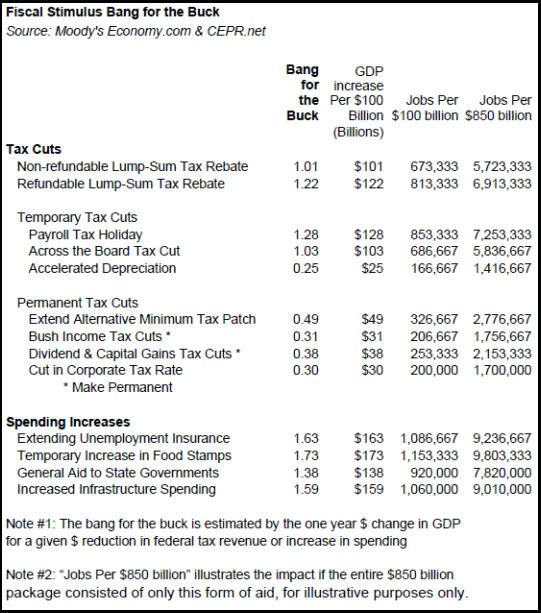
The above image, created by Paul Rosenberg at Open Left, shows figures that combine data from Moody's Economy.com and Dean Baker's Center for Economic Policy and Research. It shows the return on investment for different stimulus options. The takeaway? Food stamps, unemployment benefits, and infrastructure investment put the most money back into the economy for every dollar spent on them. Tax cuts for corporations and the wealthy do the least. (A payroll tax holiday, which is essentially a tax break for poor people, isn't so bad.) Job creation maps similarly.
So when conservatives tell you that FDR's public investment programs made the depression worse and that we need to hold fast to the conservative economic principles that created the current mess, shoot them this link. Perhaps President Obama should use that snazzy new BlackBerry of his to email it to his Republican opponents in Congress. http://www.openleft.com/showDiary.do?diaryId=11354
In the video below, commonly asked questions regarding the stimulus package are answered in clear, easy to understand terms.
Solid cutting edge infrastructure has been the secret weapon of every successful country/kingdom/empire. Our (US) interstate highway system is one of relatively few key reasons for our success. Without it we wouldn't have been able to transport goods (metals during the war, food always) across our vast country quickly and efficiently. We took one giant step forward after WWII, and it was because we put building a national infrastructure for transportation, water, power and food as well as communications on a double-step fast track. We are still working with that infrastructure in all parts of the country today, and more places than you would think still run entirely on that old system.
It is my belief that it is time to close up the foreign lending shop for a while, hang out an 'Under Construction' sign and get to work re-working our workings! We have the information and technology, the manpower the money and most of all the WILL to remake our systems into more efficient, longer lasting, safer systems that will once again throw us headlong over the goal post of expectations just as we have done in the past.
Internet communications lends itself to working from home or local 'communal' office spaces, lends itself to fewer flights, fewer buildings spewing carbon, fewer drivers, fewer accidents. The technology noted above is only a fraction of what is available.
There are still going to be jobs to be done, but new and different jobs. There will still be things to be sold, but different things. Business will not come to an end, it will just change. I think this will lead to more businesses ending up in the hands of the small business owners, the local communities. Working, shopping and eating local.

I began this search as I was watching the automakers, GAO and UAW speaking to congress. Sen. Tom Carper made a comment, rather paid a compliment to, the automakers that set me back in my seat, furrowed my brow and finally elicited a rather loud vocal response directed at the TV screen. "We face the voters, and one of the questions that is sometimes on their minds is 'what have you done for me lately'. 'And I think you are all going through a little bit of that lately too in terms of what have you done for us lately in terms of productivity..., ...bringing down the labor costs, ...what have you done for us in terms of improving quality, ...and in terms of improving fuel efficiency?' I was about to applaud, I reached for my keyboard to look this senator up as I listened intently for reactions from the big three. What I in fact heard next caused my hopes to fall, and instead of reaching to look up the senator, I went in search of his donations. "You've actually, I think any fair minded person would say on every one of those fronts, you've done a lot! You've done a lot!"
Productivity - FAIL - Any gains in this area have happened outside the borders of the US. IE Mexico
Labor costs - FAIL - Each car is sold at a loss, the reason the UAW is at the table with you.
Quality - FAIL*FAIL - Double failing grade here. With the exception of a couple of models produced only for European markets, American made cars continue to trail those from nearly every other country. Not only didn't you pass, you didn't even show up for the test.
Efficiency - FAIL*FAIL*FAIL - All of you spend millions every year to lobby congress in an attempt to stave off increasing CAFE standards. You spend millions more advertising and sponsoring large, inefficient cars, trucks, SUV's, Hummers etc and little to nothing making 'small and efficient' cool.
So naturally, I thought "he must be in the bag for the big three" and went to check donations. Not as easy as it seems. In reviewing the 'automobile manufacturers' political contributions (click here), I've had to do some adding of figures to get to a total of how much any 'one' company has contributed. The list of donors includes the usual suspects - Ford, GM, Chrysler, Nissan, Lexus, Mitsubishi and Honda. But along with those obvious are the less obvious, and suspicious. The number 5 contributor is 'Alliance of Automobile Manufactures'. What? Well, that must be for those that didn't contribute in their own name right? Wrong. A quick check of the members list for this 'alliance' finds familiar names, BMW, Mercedes, Mazda, Porsche and Volkswagen. Fine. But in addition to those names, we find (again) Chrysler, Ford, GM, Mitsubishi and Toyota! The total contributions for the Alliance were $21,850. With 10 members, that's $2185 each. Not much. Next comes a contributor called 'General Parts International', hmmm.. That's CarQuest Autoparts.... anyway. Daimlerchrysler is listed twice, once as mentioned and once as daimler chrysler. $6500 and $5650 contributed for a total $12150. Another name not expected is Badenoch LLC. This is a research and development Co with an NAICS of industrial design services. Yeah, that fits in with automobile manufacturers. Can you say creative accounting boys and girls?
I didn't find a lot of direct contributions to this senator from the auto industry, just some. I went back to his bio and it hit me. Mr. Carper is a senator from Delaware. The corporation capital of the country. ( I was going to say world, but that's just not so anymore, is it?)
I don't know a lot about this senator, might he have been calming the waters before dive bombing? His remarks were next directed to Mark Zandi, thanking him for previously providing what he calls a 'bang for the buck' reports, and asks for his opinion on the biggest bang for the buck here. Zandi says the government should provide aid, there is no choice. The cost of ensuring that the automakers don't go into bankruptcy in the next 3-4 years is going to cost more than $34 billion. He gave a range of $75-125 billion. Per Zandi, this is the total number taxpayers will be on the hook for, that includes hart (he was hard to understand here, could be 'our' 'art' or some other acronym) money, sec136 money... Zandi goes on to say that if they (the automakers) stick to the script, they will come out very viable companies. The problem according to Zandi is that sticking to the script outside of bankruptcy is going to be very, very difficult. Mentioning stakeholders, creditors, the UAW, suppliers and dealers all to deal with. So plan on them not sticking to the script. Zandi says allocate $34 billion for them but not all at once. GM wants $10bil to get them through to March 31st. Chrysler needs $7bil. Ford doesn't need anything. Zandi would give them this much of the $34bil to avoid any bankruptcy through Mar31. He agrees with a board for oversight, and especially the idea of a single person in the short term to streamline and expedite the recovery plan. At the Mar31 deadline, benchmarks must have been met to receive the next round of funding. He also suggests the companies use the time between now and then to prepare for bankruptcy. He concludes by insisting everyone stick to the idea that 'this is it'.
Carper follows the comments by Zandi with a single question about how to ensure a reasonable return to the taxpayers in order to take on the risk, which is answered by one witness with no followup questions. Carper then goes on to say that he doesn't think the automakers are getting enough credit for what they have already done! He thinks these 3 companies 'have positioned themselves to make a go it' within a couple of years. ... Ford has been in operation since 1903, General motors since 1908 and Chrysler since 1925. And they've positioned themselves over the past couple of years to 'make a go of it'? Oh really!
The GM balance sheet for the past 3 years stacks up like this: Net tangible assets (assets-liabilities including stock value) '05 $10,258,000 '06 ($6,559,000) '07 ($38,160,000) http://finance.yahoo.com/q/bs?s=GM&annual
Ford comes up like this '05 $7,497,000 '06 ($40,236,000) '07 $3,559,000 http://finance.yahoo.com/q/bs?s=f&annual
and Chrysler (Daimler AG, DAI) like this '05 $37,162,919 '06 $41,862,752 and '07 $48,646,941 (keeping in mind a majority of this company's business is outside the US) http://finance.yahoo.com/q/bs?s=dai&annual
It's fun to note that when I went to the chryslerllc.com website, the splash pages says this (and only this)
"It's not a bailout to keep us from failing. It's a loan to help us succeed. We are investing in the creation of new technologies for more environmentally responsible vehicles, reduced emission vehicles and emission free electric vehicles. As early as 2010 our exciting lineup of vehicles will offer an electric drive system. With a link to read more about their plan for a successful future, to learn more about their ENVI vehicles and a link to watch a video so that you may "See why you should care about the US auto industry". But I digress.
Senator Carper, your remarks today weren't in keeping with reality. Not only have these 3 companies had the time and experience to 'make a go of it' without any help, they haven't held to the 'free market' diatribe and they haven't performed in their own shareholder's best interests, much less the best interests of their employees or their customers. They've asked for and been given - repeatedly - tax breaks, incentives, grants and loans all with the promise of 'new technology', 'more efficient vehicles' and 'world class quality and safety'. These three automakers together make up the number 2 position in the world for sales http://en.wikipedia.org/wiki/Automaker, while being last in the world for quality, efficiency and safety. What in the world were you thinking with this thinly veiled attempt at questioning that was, in fact, 7 minutes of undeserved compliments and praise?
By Tom Zeller Jr.
As part of James Kanter’s post last week on the efforts of one nuclear power company to solicit proposals from architectural firms on ways to improve the visual impact of nuclear power plants, we asked readers for their ideas.
Needless to say, there were lots of opinions — many of them taking issue with the very premise of the exercise. We also received a number of drawings, photographs and other artistic efforts reflecting a variety of viewpoints. Herewith, we offer a selection of those.
(Note: We’ll continue to feature your artwork and thoughts on the idea of a nuclear power renaissance as we receive them — though we reserve the right to excerpt and edit for clarity and brevity. Keep your thoughts short and your artwork of manageable size, folks. Send them here: greeninc nytimes com.)
Dylan Wolfe, an assistant professor of visual communication at Clemson University, offered the following entry — and a bit of social engineering — toward a safer nuclear energy program:
1. Construct power plants in the richest neighborhoods in the country.
2. Keep nuclear waste inside the homes of those same neighborhoods.
Bill Gates, for example, would have the influence and capacity to assure that the plants were safe and well-maintained. Keeping the waste local solves the transport and disposal problem — plus, Mr. Gates will certainly monitor his share of the waste diligently. The only additional measure required would be to create mandatory residence restrictions, so that the residents don’t try to move out.
But hey, those neighborhoods already have conveniently located gates
Click Here to see the other submissions.
By Bob Maschi
Election results are in and they clearly indicate that Democrat Barack Obama has cost Peace and Freedom’s candidate, Ralph Nader, the presidency. Simple math proves that had Obama not run, and had all of his support gone to Nader, that Nader would have easily won the majority of Electoral College votes and, therefore, the presidency.
A similar electoral flaw occurred in the 2000 presidential election when Al Gore cost Ralph Nader the presidency." Courtesy of Peace and Freedom
The 380,000-plus-word database presented here allows, for the first time, the Iraq-related public pronouncements of top Bush administration officials to be tracked on a day-by-day basis against their private assessments and the actual “ground truth” as it is now known. Throughout the database, passages containing false statements by the top Bush administration officials are highlighted in yellow. The 935 false statements in the database may also be accessed by selecting the “False Statements” option from the “Subject” pull-down menu and may be displayed within selected date ranges using the selection tool below. Searches may also be limited by person or subject, or both, by using the appropriate selections from the pull-down menus.


 Posts
All Comments
Posts
All Comments